GTM Engineer
Core GTME
Qualified GTM engineer jobs, posted pay, role scope, and a practical way to use the archive with the newsletter to find active openings.
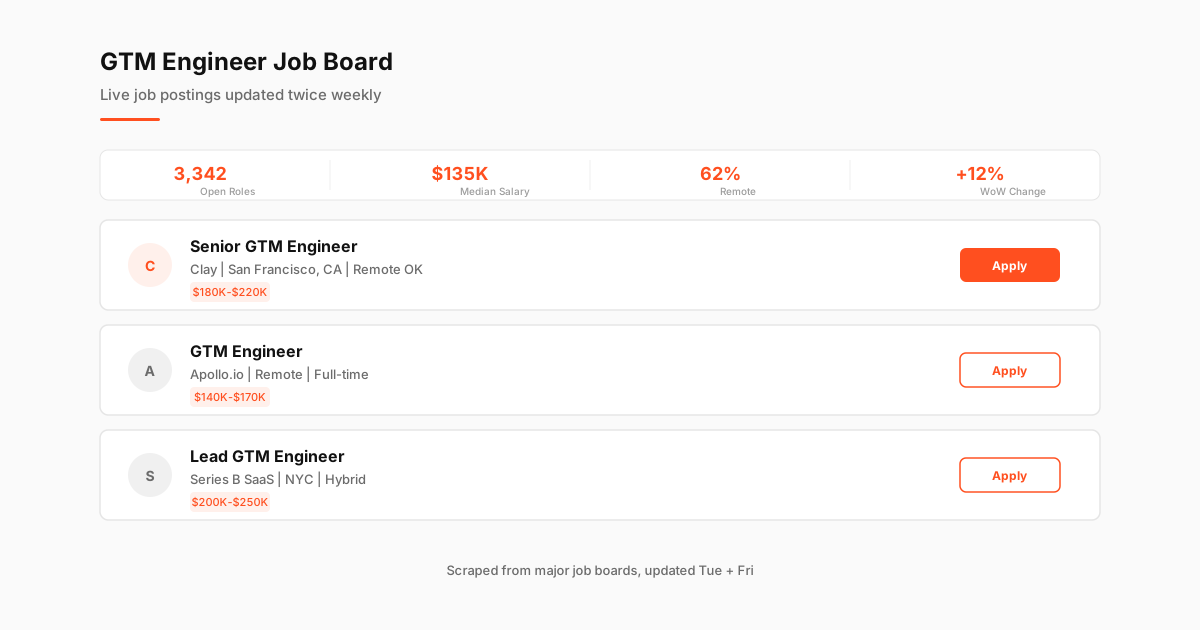
GTM engineer jobs are growing fast, and the title now attracts a lot of baggage. Some employers need someone to build the systems that turn revenue teams into better operators. Others have pasted a fashionable label onto a conventional sales, marketing, RevOps, or product role.
This page separates the qualified work from the noise.
GTM Engineer postings grew 5,205% from 2024 to 2025, going from 63 to 3,342 postings, according to GTME Pulse job market analysis. That kind of growth creates a market worth studying, especially for operators who can work across data, automation, integrations, and the messy handoffs that slow down a revenue team.
The archive preserves a dated sample of qualified roles and posted compensation. The newsletter carries the active opportunity set. Read both before applying, then confirm every opening on the employer’s page.
The title moved from a niche label into a hiring category in a short span. GTM Engineer postings grew 5,205% from 2024 to 2025, going from 63 to 3,342 postings, according to GTME Pulse job market analysis.
That does not mean every company hiring under the label has figured out the role. It means companies have started admitting they need technical people closer to revenue work. The backlog is familiar: bad enrichment, broken routing, scattered tooling, untrusted reporting, brittle integrations, and AI experiments with nobody accountable for making them useful.
A strong GTM engineer can take ownership of that work. They can translate the operational needs of sales, marketing, customer success, and RevOps into systems that run. The employer gets faster execution and fewer spreadsheet rituals. The candidate gets a role with real proximity to commercial outcomes.
The archive is useful because it preserves the details job boards flatten. Titles alone do not tell you whether a role involves building workflow infrastructure, maintaining a CRM, supporting a single team, or acting as an internal consultant across the revenue organization. Job descriptions and posted compensation give you a much better read.
Founders can use the same material to see how the market describes the work. If you are hiring, the question is whether the person will own a narrow system or carry responsibility for the connective tissue across your go-to-market stack. Those are different jobs, even when the title looks identical.
For the broader hiring picture, read the job market analysis. It gives the title’s growth some needed context and helps distinguish a durable category from a temporary naming spree.
A qualified listing needs more than a trendy title. The role has to sit near the revenue organization and show evidence that the person will build, improve, or own technical systems used by that organization.
Core listings are straightforward. They use GTM Engineer or go-to-market engineering titles and describe work associated with the function. That might include enrichment, routing, data architecture, tooling, integrations, workflow design, AI-assisted processes, or systems that give revenue teams cleaner inputs and faster execution.
Adjacent listings require more judgment. Companies do not use a shared vocabulary yet, and plenty of relevant work sits under titles such as growth engineer, revenue systems engineer, sales automation engineer, or technical operations lead. A role belongs in the qualified set when its remit clearly serves a revenue team and the work involves automation, data, integrations, workflows, or AI ownership.
Generic functions do not qualify merely because they touch revenue. A sales role that uses a CRM is still a sales role. A marketing role that owns campaign operations is still marketing. RevOps and product roles belong in their own categories unless the description gives the person responsibility for building the technical systems behind commercial execution.
| Listing type | What qualifies | What is excluded |
|---|---|---|
| Core GTM engineering | A GTM Engineer or go-to-market engineering title with ownership of revenue systems, automation, data, integrations, workflows, or AI | Roles with the title but no technical systems remit |
| Adjacent GTM engineering | A revenue-team remit plus clear ownership of automation, data, integrations, workflows, or AI | Generic sales, marketing, RevOps, and product software roles |
| General commercial work | n/a | Jobs where systems work is incidental to selling, marketing, account management, or ordinary operations |
This taxonomy is deliberately strict. A broad count produces a bigger headline and a worse resource. Candidates need to know whether they are applying for work that builds commercial infrastructure or a conventional job with a few automation tasks attached.
Read the listing closely for ownership language. “Support,” “assist,” and “maintain” can describe perfectly good jobs, but they usually indicate a different level of authority from “design,” “build,” “own,” or “architect.” The difference shows up in the day-to-day work, the interview process, and the compensation conversation.
The best roles also reveal how the company thinks about its revenue engine. A company that gives one person access to data, tools, stakeholders, and a clear mandate has made a real bet on the function. A company that expects one hire to fix every reporting problem while running demand generation, sales operations, and customer marketing has written a shopping list.
That distinction is useful before you apply. It is even more useful before you accept.
If you are still figuring out whether this work fits your background, how to become a GTM engineer outlines the skills and operating habits that show up most often in qualified roles.
Posted salary ranges are useful evidence, though they are never the whole story. Scope, location, seniority, equity, benefits, and the company’s stage all shape an offer. The archive lets you compare ranges attached to actual role descriptions instead of relying on a title that different employers use differently.
The archive preserves 65 qualified listings from the 2026-05-04 export, including 36 usable pay records, according to the GTME Pulse jobs archive. That sample is best read as a record of what employers chose to disclose, not a complete account of every offer in the market.
The broader salary dataset covers 228 survey respondents across 32 countries plus 3,342 analyzed job postings, according to GTME Pulse salary data. It gives candidates a wider benchmark than the archived listings alone, while preserving the distinctions that make this market difficult to express with a single number.
Mid-level is the largest salary cohort at 78 respondents, according to GTME Pulse salary data. That makes the dataset particularly useful for candidates moving from RevOps, sales operations, growth, data, or technical consulting into GTM engineering.
Use the GTM engineer salary data alongside the rows below. Look for patterns in the work as well as the range. Roles that own the data model, routing logic, integration layer, and operational roadmap generally demand a different profile from roles focused on administering a toolset. A company may use the same title for both. The job description will tell you which one you are looking at.
Posted pay also helps founders calibrate a search. A vague mandate paired with a narrow budget tends to attract the wrong candidates. The market is rewarding people who can diagnose commercial bottlenecks, work with technical systems, and ship changes that teams adopt. That is a hard combination to find, and pretending otherwise usually lengthens the search.
This is an archive for research. The listings came from the dated site export and may have closed. Treat the rows as a record of employer behavior, role design, locations, titles, and posted pay.
The archive preserves 65 qualified listings from the 2026-05-04 export, including 36 usable pay records, according to the GTME Pulse jobs archive. Use that historical sample to build a target list of employers, identify recurring language, and see which companies describe the role with enough specificity to be worth your time.
Then move to the newsletter for the live sample. The latest newsletter issue reports 19 active listings as of August 31, 2026, according to the GTME Pulse jobs archive. That is where a job seeker should start when the goal is an application rather than market research.
The workflow is simple. Study the archive to understand what qualified roles look like. Read the current newsletter issue for active openings. Visit the employer’s page before applying, because hiring moves fast and a page that was live when it entered the sample may already be closed.
The newsletter methodology explains how the qualified opportunity set is built and what enters the count. It is worth reading if you are using the archive to compare markets, assess hiring demand, or decide whether an adjacent role belongs in your search.
Candidates often make the mistake of searching only for the exact title. That misses employers that have not adopted the label but are hiring for the underlying work. The taxonomy on this page gives you a better filter: revenue-team ownership plus systems work. Search for those responsibilities in descriptions, then judge the role on its substance.
Founders should use the archive in reverse. Find the listings that describe the work you need done. Notice where the scope is concrete and where it has become an all-purpose operations request. The market has enough examples now to make a sharper hiring brief possible.
The title is growing. The useful question is whether the job gives someone enough authority, access, and focus to build work that sticks.
65 archived listings