Unify: Data Enrichment and GTM Automation, Reviewed
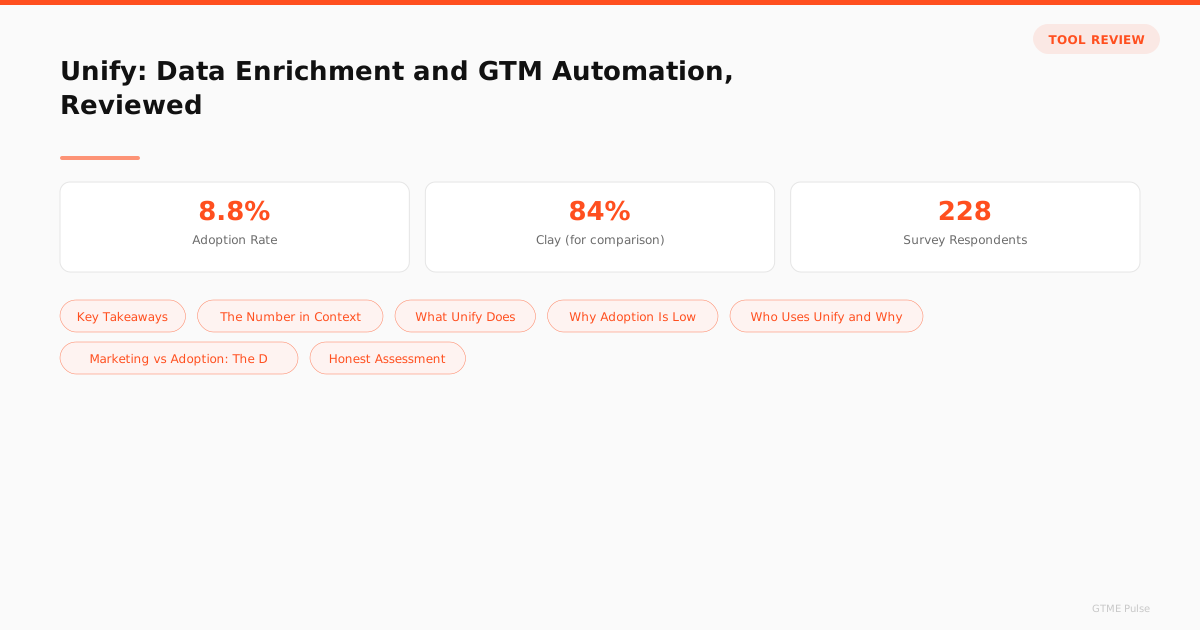
Unify bundles data enrichment, intent signals, and outbound sequencing into one GTM automation platform. The pitch is consolidation: one tool instead of Clay plus a sequencer plus an intent vendor. The adoption data complicates that pitch. 8.8% of 228 surveyed GTM Engineers use it, against 84% for Clay. Here's how the enrichment and automation hold up, and where Unify fits.
The Number in Context
8.8% adoption. That's roughly 20 out of 228 surveyed GTM Engineers who report using Unify. For a tool with significant marketing investment and visible presence in the GTM Engineering community, this number deserves honest analysis.
For context: Clay sits at 84%. CRM adoption is 92%. Even n8n, a relatively technical workflow tool, has 54% adoption. Unify's 8.8% puts it in the same tier as niche tools with minimal marketing presence. The gap between Unify's visibility and its adoption is the story.
What Unify Does
Unify positions itself as a multi-channel outbound orchestration platform. The pitch: manage email, LinkedIn, and phone outbound from a single platform with built-in lead enrichment, sequence automation, and intent signals.
The product combines functions that GTM Engineers currently spread across multiple tools. Instead of Clay for enrichment + Instantly for email + HeyReach for LinkedIn + 6sense for intent data, Unify aims to consolidate those into one platform. On paper, this is the "all-in-one outbound tool" that practitioners say they want (it's the #1 item on the tool wishlist).
The execution challenge is that each of those specialized tools has years of feature depth in its category. Clay's enrichment layer pulls from 75+ data providers. Instantly manages hundreds of sending accounts with sophisticated warmup algorithms. Consolidating those capabilities into a single platform without compromising depth is an engineering problem that hasn't been solved yet in this space.
Data Enrichment and GTM Automation: How It Works
Two questions drive most searches that land here. Is Unify any good at data enrichment, and does the GTM automation hold up against a purpose-built stack? Short answer: the enrichment is fine for company and contact resolution, the automation covers the basics, and both trail the category leader when you push on depth.
Unify's enrichment runs a provider waterfall behind the scenes and layers in website-visitor de-anonymization, so you can turn anonymous traffic into named accounts and route them straight into a sequence. That pipeline (resolve, enrich, sequence) is the whole product in one flow. The catch is control. You don't pick which provider fills the mobile number or the job title the way you would in a Clay table. You get Unify's opinionated result. For teams that want the data and don't want to tune a waterfall, that's a feature. For GTM Engineers who treat enrichment as a per-field problem, it's a ceiling.
Here is where each layer lands against the specialist most GTM Engineers would otherwise reach for.
| Capability | Unify | Specialist tool | Who wins on depth |
|---|---|---|---|
| Contact & company enrichment | Built-in waterfall, bundled | Clearbit, Apollo, ZoomInfo | Specialist (field-level control) |
| Enrichment orchestration | Opinionated, low-config | Clay (75+ providers) | Clay |
| Email sequencing & deliverability | Native, basic warmup | Instantly, Smartlead | Specialist |
| LinkedIn outbound | Native integration | HeyReach, Expandi | Roughly even |
| Intent / visitor signals | Built-in de-anonymization | 6sense, Common Room | Specialist (signal breadth) |
| One consolidated workflow | Yes, single platform | None (multi-tool stack) | Unify |
Read down the "who wins" column and the pattern is clear by the row, not by a slogan. Unify wins exactly one thing: putting all of it in one place. Every individual capability has a sharper alternative. That's the trade every all-in-one platform makes, and it's why the practitioners who score highest on technical depth tend to build with Clay plus a dedicated sequencer instead. If you're weighing Unify mostly for the enrichment, the Apollo alternatives comparison covers the pure-data options in more detail.
Why Adoption Is Low
Three factors explain the gap between Unify's marketing and its adoption numbers.
Clay's gravitational pull. With 84% adoption, Clay owns the enrichment and orchestration layer. GTM Engineers have invested time learning Clay's interface, building complex enrichment tables, and integrating it with their workflow tools. Switching to Unify means abandoning that investment. And Clay keeps shipping new features (AI enrichment columns, improved integrations) that reinforce the switching cost.
Tool-stack inertia. GTM Engineers build multi-tool workflows over months. An active operation might have Clay feeding enriched leads to Instantly for email sequences, HeyReach for LinkedIn outreach, and n8n orchestrating the data flow between all of them. Replacing three tools with one requires rebuilding workflows from scratch. The potential consolidation benefit has to be enormous to justify that disruption.
Pricing alignment. Unify's pricing targets mid-market and enterprise buyers. Many GTM Engineers work at agencies, startups, or as freelancers where tool budgets are tighter. The per-seat pricing model fits a sales team better than a one-person GTM operation. Clay's usage-based credit model scales more naturally with individual practitioners who want to pay for what they use.
Who Uses Unify and Why
The 8.8% who do use Unify cluster around specific profiles. Mid-market sales teams (20-100 employees) that want a single platform for outbound. Companies where the "GTM Engineer" is closer to a sales ops manager than a technical builder. Teams prioritizing LinkedIn outbound as a primary channel, where Unify's native LinkedIn integration adds value over the Clay + HeyReach combination.
These users tend to value simplicity over flexibility. They want fewer tools to manage, fewer integrations to maintain, and a more opinionated workflow. That's a valid preference. The GTM Engineering community skews toward technical practitioners who prefer building custom stacks from specialized tools, which biases the survey away from Unify's target user.
Marketing vs Adoption: The Disconnect
Unify's marketing is well-executed and highly visible. Sponsored content, LinkedIn presence, event appearances, and practitioner testimonials create the impression of widespread adoption. But marketing visibility and actual adoption are different metrics.
This disconnect is common in GTM tools. Vendors invest heavily in awareness before the product has achieved category leadership. The result: practitioners see the marketing everywhere and assume everyone else is using it. Survey data reveals the reality. At 8.8%, Unify has awareness without corresponding adoption.
For comparison: n8n spent almost nothing on marketing and achieved 54% adoption through word-of-mouth and community recommendations. Clay's early growth was driven by practitioners sharing their workflows on Twitter and LinkedIn, not paid campaigns. In the GTM Engineering community, peer recommendations and visible use cases drive adoption more than marketing spend.
Honest Assessment
Unify is solving a real problem. GTM Engineers do want consolidated outbound tools (that's the #1 wishlist item). The question is whether Unify can match the depth of specialized tools while delivering on the consolidation promise.
At 8.8% adoption, the market hasn't validated that trade-off yet. That could change. Unify has funding, an active engineering team, and a clear product vision. But in a market where Clay has 10x the adoption and a two-year head start on integrations and community, the path to meaningful market share requires either a breakthrough feature that Clay can't replicate or a fundamentally different user persona than the current GTM Engineer community.
We'll update this analysis as adoption data changes. For the broader tool ecosystem, see the tech stack benchmark. For what the Clay deep-dive reveals about why switching costs are so high, check that analysis.
Frequently Asked Questions
What is Unify's adoption rate among GTM Engineers?
8.8% of surveyed GTM Engineers report using Unify. That puts it well below the category leaders: Clay at 84%, CRM tools at 92%, and even workflow automation at 54%. The low adoption exists despite Unify's significant marketing presence in the GTM Engineering community.
Why is Unify's adoption so low despite marketing?
Three factors. First, Clay already owns the enrichment and orchestration layer for 84% of practitioners, leaving little room for an alternative. Second, Unify's multi-channel outbound pitch overlaps with tools teams already use (Instantly, Smartlead, HeyReach). Third, the pricing model targets mid-market and enterprise buyers, while many GTM Engineers are at agencies or startups with tighter budgets.
Should I use Unify or Clay for GTM Engineering?
The data strongly favors Clay for most GTM Engineering workflows. At 84% adoption vs 8.8%, Clay has a larger ecosystem, more community resources, more job postings requiring it, and broader integration support. Unify may fit specific use cases around multi-channel outbound orchestration, but it's not a Clay replacement for enrichment-centric workflows.
How does Unify's data enrichment work?
Unify enriches contact and company records using a built-in provider waterfall plus website-visitor de-anonymization. You define an audience, Unify resolves company and person details, then routes those records into automated email and LinkedIn sequences. The enrichment is bundled into the platform rather than exposed as a standalone table builder, so you get less granular control over which provider fills each field than you would in Clay or a dedicated enrichment stack. For provider-by-provider depth, a Clay table calling 75+ sources still wins.
Is Unify a full GTM automation platform or just enrichment?
Unify markets itself as end-to-end GTM automation: enrichment, intent signals, sequence orchestration, and reporting in one workflow. That breadth is the pitch. The trade-off is depth. Each layer competes with a specialist (Clay for enrichment, Instantly or Smartlead for email infrastructure, HeyReach for LinkedIn, 6sense for intent), and Unify trails the leader in every individual category. It fits teams that value one consolidated workflow over a best-of-breed stack.
What are the best Unify alternatives for data enrichment and automation?
For enrichment-first automation, Clay is the default and pairs with Instantly or Smartlead for sending. If you want pure data coverage, compare Clearbit, Apollo, and ZoomInfo. See our Clay alternatives roundup and Apollo alternatives guide for the full breakdown. Most GTM Engineers assemble Clay plus a sequencer plus n8n rather than adopting a single all-in-one like Unify.
Source: State of GTM Engineering Report 2026 (n=228). Salary data combines survey responses from 228 GTM Engineers across 32 countries with analysis of 3,342 job postings.