Automate Lead Routing With Claude Code: A GTM Engineer's Guide
Lead routing breaks when volume outgrows manual rules.
Sales reps wait on stale assignments. Ops teams patch CRM workflows with spreadsheets and Slack pings. The lag between capture and contact grows, and conversion rates drop with it. Most routing tools were built for static territories and predictable lead sources.
They handle simple assignment rules fine but choke when you add intent signals, account fit scores, or multi-product routing paths. Claude, Anthropic's language model, gives GTM engineering teams a different tool. You prompt it to generate routing scripts in Python or JavaScript.
Those scripts parse lead data, apply business rules, and return owner assignments through API calls. The model writes code. Your team reviews, tests, and deploys it. This guide covers the implementation patterns, data requirements, integration points, and maintenance trade-offs that determine whether Claude-generated routing holds up in production.
Why Lead Routing Breaks at Scale
Most routing systems fail for predictable reasons. Territory definitions shift quarterly while CRM assignment rules stay static. New lead sources arrive from events, paid campaigns, partner referrals, and API integrations, each carrying different data quality.
- Others show up as a name and email, forcing ops to run enrichment before assignment can happen.
- The lag compounds quickly across high-volume sources and weekend traffic.
- A lead sits in a queue while enrichment runs.
Some leads arrive with full firmographics. Then it hits a routing rule pointing to a rep who left last month. The fallback is manual triage in Slack, which means someone scrolls, picks a rep, and assigns by hand. Static rules also ignore context.
A lead from a Fortune 500 account should route differently than one from a small startup, even if both come from the same form. CRM workflows rarely account for this distinction. They assign by territory or round-robin, missing signals like industry fit, tech stack, or engagement history.
High-value accounts get the same treatment as low-fit leads. Reps waste time on poor matches while good leads go cold waiting for contact. Before adopting any routing tool, map where your current process breaks. Track the time between lead capture and first contact.
Count how many leads land in wrong or stale queues. Identify which sources produce the most incomplete records. These measurements tell you what the new system must solve.
Claude as a Code Generator, Not a Decision Engine
Claude does not decide who owns a lead. It writes code that implements rules your team already defined. You prompt it to generate functions in Python or JavaScript that parse lead data and return routing decisions based on your business logic.
- The model translates business requirements into executable scripts.
- You provide the rules, the data schema, and the expected outputs.
- Claude produces a function that takes a lead object and returns an owner ID, a queue name, or an escalation flag.
This distinction matters because teams sometimes expect the model to infer routing policy from vague descriptions. That approach produces inconsistent results. Claude works best when you give it explicit conditions: if industry is X and country is Y, route to owner Z. The model handles the code structure, edge cases, and formatting.
Start with the records your team actually needs. A routing script is only as good as the data it receives. Missing fields force fallback logic, and fallback logic produces wrong assignments. Sample testing with real lead records exposes gaps before deployment.
Claude can also generate helper functions for data transformation. If your CRM stores company size as a range, Claude can write a parser that normalizes it to a numeric value. If your enrichment provider returns industry codes, Claude can map them to your internal taxonomy. The model handles the plumbing.
Your team owns the policy. Test sample records against the exact fields your workflow needs. Confirm how updates flow into the CRM or warehouse. Document which errors would create sales or reporting risk if routing scripts produce wrong outputs.
Data Inputs That Make or Break Routing
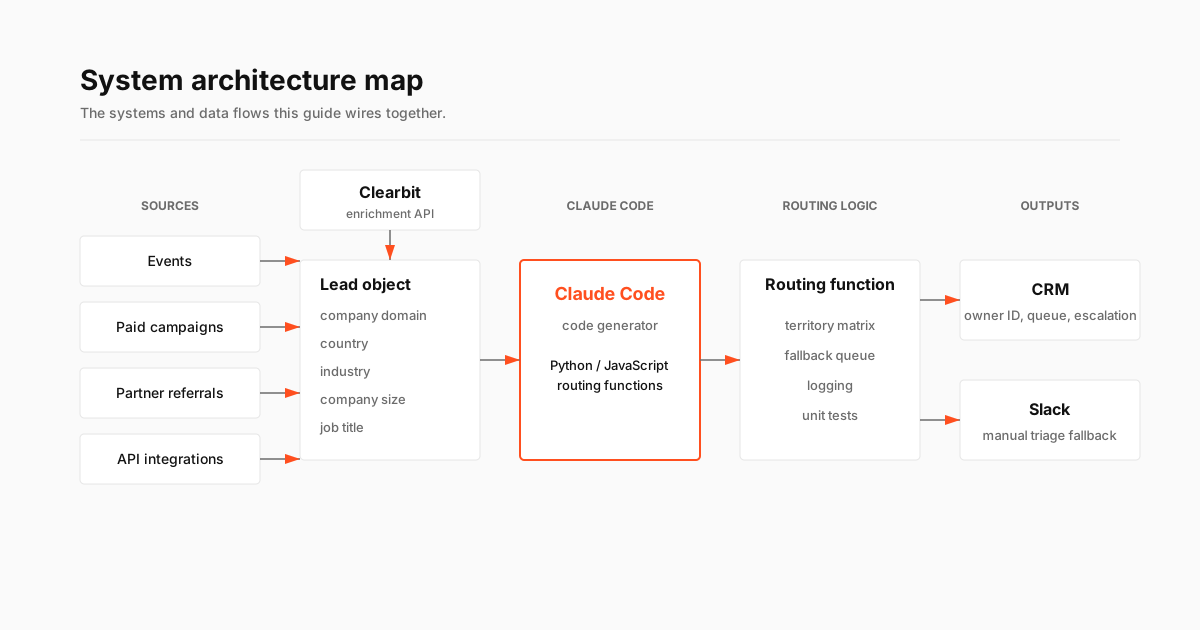
Routing accuracy depends on input quality. Missing company domains or job titles force fallback rules that send leads to generic queues. Claude can generate scripts that call enrichment APIs like Clearbit, but it cannot invent reliable signals from incomplete data.
- The first step is defining what fields your routing logic requires.
- Company domain, employee count, industry, country, and job title are common inputs.
- Without them, routing scripts default to round-robin or territory-based assignment, which ignores account fit entirely.
Define required fields, acceptable fallbacks, and confidence thresholds before writing any routing code. If a lead arrives without a company domain, should the script attempt enrichment, route to a default queue, or flag for manual review? These decisions belong to your ops team, not the model.
Scripts must include validation guards and logging to track edge cases. A routing function that receives an unexpected data format should log the error and fall back to a safe default, not crash silently. Claude can generate these guards when you specify them in the prompt. Map the workflow before choosing the platform.
The practical test is whether data moves cleanly between the systems that sales, marketing, finance, and operations already use. Ownership matters because broken mappings usually show up after the purchase, not during the demo. List the systems that must exchange data after launch. Assign owners for mapping, testing, errors, and release review.
Check whether support matches the team that will operate the routing system day to day.
Building Routing Logic With Claude-Generated Scripts
Start with a clear policy: route by country and industry, or by tech stack fit. Prompt Claude to generate a function that takes a lead object and returns an owner ID. Use structured prompts with examples of input data and expected outputs.
- A good prompt includes the lead schema, the routing rules, and the fallback behavior.
- For example: given a lead with country, industry, and company_size fields, return the owner ID based on a territory matrix.
- If no match exists, return a default queue ID.
Claude generates the function with conditionals, comments, and basic error handling. Refine the output by asking Claude to add logging statements, type checks, and unit test stubs. The goal is production-ready code, not a one-off script. The output becomes part of an automation pipeline that runs on every inbound lead.
Keep routing rules in a configuration file separate from the routing function. Claude can generate a loader that reads rules from JSON or YAML, which means ops can update routing matrices without touching code. This separation makes the system maintainable. Name the owner for setup, QA, and renewal review.
Capture the workflow that must work after launch. Record what would make the option a poor fit before committing to the architecture. The useful question is whether the choice changes who owns setup, cleanup, QA, renewal risk, and day-to-day reporting.
If that ownership is unclear, the buyer has more discovery work to do before the system goes live.
Integrating With CRM and Marketing Tools
Claude-generated code must connect to real systems. Use it to write API clients for Salesforce, HubSpot, or Marketo that update owner fields when a routing decision is made. Scripts can run in AWS Lambda, triggered by form submissions or webhook events from your marketing platform.
- Authentication, rate limits, and retry logic are mandatory components.
- Claude can draft these pieces, but they require manual configuration and monitoring.
- Retry logic needs exponential backoff and dead-letter queues for failed writes.
OAuth tokens expire. API rate limits change. The integration layer is where most routing automation projects stall. The routing logic itself is straightforward.
The plumbing between your form, your enrichment provider, your routing function, and your CRM is where teams spend the bulk of their time. Claude can generate boilerplate for common patterns: a Lambda handler that receives a webhook, calls an enrichment API, runs the routing function, and writes the owner assignment to the CRM.
You still need to configure environment variables, secrets, and IAM roles yourself. List the systems that must exchange data after launch. Assign owners for mapping, testing, errors, and release review. Check whether support matches the team that will operate the integration day to day.
The practical test is whether data moves cleanly between the systems that sales, marketing, finance, and operations already use. Broken mappings usually show up after the purchase, not during the demo. Plan for the failure modes before going live.
Testing and Versioning AI-Generated Routing Code
Treat Claude's output as a first draft. Run unit tests against known lead profiles to verify routing accuracy before deploying anything. Store scripts in version control with the same discipline you apply to application code.
- Create a test suite with representative lead records: enterprise accounts, SMB leads, international records, and edge cases like missing fields.
- Each test asserts that the routing function returns the expected owner ID.
- When rules change, update the tests first, then regenerate the routing function.
Tag deployments by rule version and date. When a routing change causes a spike in misassigned leads, you need to identify which version introduced the problem. Version tags make rollback straightforward. Automated testing prevents regressions.
If Claude generates a new version of the routing function, the test suite catches behavior changes before they reach production. This is especially important because Claude's outputs can vary between model versions or prompt revisions. Name the owner for setup, QA, and renewal review. Capture the workflow that must work after launch.
Record what would make the option a poor fit before committing to the architecture. The useful question is whether the choice changes who owns setup, cleanup, QA, renewal risk, and day-to-day reporting.
If that ownership is unclear, the team has more discovery work to do before the system goes live and starts handling real lead traffic.
Handling Edge Cases and Fallbacks
Not every lead fits the model. Unroutable leads, ambiguous firmographics, or conflicting signals require fallback paths. Claude can generate default queue assignments or escalation logic, but the design must be explicit in the prompt.
- When a routing function cannot match a lead to an owner, it should write a record to an error log with the lead ID, the input fields, and the reason for the fallback.
- This creates an audit trail for ops to review and improve routing rules over time.
- If enrichment returns a low match score, or if the lead matches multiple territories, route to a review queue instead of guessing.
Scripts should log decisions, not fail silently. Include human-in-the-loop triggers for low-confidence cases. Claude can generate the conditional logic for these triggers, but the thresholds come from your ops team. Common edge cases include leads with free email domains, companies not in the enrichment database, and leads from countries without assigned territories.
Each case needs a documented fallback behavior. A lead from an unassigned territory should not sit in a queue for days because nobody defined the default owner. Name the owner for setup, QA, and renewal review. Capture the workflow that must work after launch.
Record what would make the option a poor fit before committing to the architecture. The useful question is whether the choice changes who owns setup, cleanup, QA, renewal risk, and day-to-day reporting.
Operational Overhead and Maintenance Realities
AI-generated code reduces setup time, not long-term maintenance. Territory changes, new products, or CRM updates require prompt revisions and retesting. Claude's outputs can vary between versions, so pin to specific model releases and document which version produced each routing script.
- Over time, enrichment providers change their schemas, CRM APIs add new required fields, and territory definitions shift.
- A routing function that worked at launch can silently produce wrong assignments months later because an upstream dependency changed without notice.
- Set up alerts for routing failures, not just system errors.
Monitor execution logs for drift. A routing function that returns a default queue for every lead is technically working, but it signals a broken rule or a data problem. Track the percentage of leads hitting fallback paths and investigate when that rate climbs. Separate product fit from account fit.
Large platforms can solve real workflow problems, but they also bring packaging, admin, and migration questions. The page should help the buyer decide which questions to ask before a demo becomes procurement. Confirm which team owns data hygiene after implementation. Map the handoff between sales, marketing, and operations.
Check whether reporting stays useful without manual cleanup. The decision framework is simple: if no one owns the routing rules after launch, the system will drift. Assign ownership before deployment, not after the first misrouted enterprise lead reaches the CRO.
Frequently Asked Questions
Can Claude route leads without writing code?
Not reliably. Claude can suggest rules or configurations for no-code tools, but scalable, auditable routing requires code. Direct API integrations, data transformations, and conditional logic are better handled through scripts that Claude generates, but does not execute autonomously.
How do I prevent misrouted leads due to bad AI output?
Treat Claude-generated code as untrusted until tested. Implement unit tests with sample leads, validate outputs before deployment, and include logging to trace decisions. Use Claude to draft logic, then review and test before deploying.
What systems can Claude-generated routing scripts integrate with?
Any system with a documented API. Common integrations include Salesforce, HubSpot, Marketo, Pardot, and custom CRMs. Scripts can also trigger workflows in Zapier or Segment if needed.
Do I need to run Claude locally to use it for routing?
No. Most teams use the hosted API via Anthropic. You do not need local inference. The model generates code that runs in your environment. Claude itself does not process leads in real time.
How often should routing logic be updated?
Whenever business rules change: new sales teams, product launches, or territory adjustments. Treat routing logic like any other business-critical code. Version it, test it, and review it on a fixed cadence rather than waiting for problems.

Rome Thorndike
Rome Thorndike is the CEO & Founder of Provyx, which provides GTM intelligence and data validation for healthcare companies, including EngagedMD and BTL Industries. He helped establish HubSpot reporting at Pacdora, owned pipeline reporting at Datajoy, and led revenue at Firmograph.
Connect on LinkedIn