How to Deduplicate CRM Records Using Claude Code: A GTM Engineer's Guide
CRM databases rot from within.
Duplicates aren't just noise-they're operational debt. Manual cleanup doesn't scale. Scripted automation does. This guide walks through using Claude-generated code to identify, resolve, and prevent CRM record duplication. No hand-waving, no hypotheticals. Just working patterns, tested against real data structures and API constraints.
Why CRM Duplicates Break Workflows
Duplicate records disrupt lead routing, reporting accuracy, and compliance. They create conflicting ownership, inflate contact counts, and trigger redundant communications. When multiple records exist for one customer, sales teams waste time reconciling data instead of selling.
- Compliance systems may fail to track consent correctly.
- These issues compound with every integration and sync cycle.
Reporting reflects inflated or fragmented activity.
Map the workflow before choosing the platform. The practical test is whether data moves cleanly between the systems that sales, marketing, finance, and operations already use. Ownership matters because broken mappings usually show up after the purchase.
- List the systems that must exchange data after launch.
- Assign owners for mapping, testing, errors, and release review.
- Check whether support matches the team that will operate it.
Decision note: Decision note: In How to Deduplicate CRM Records Using Claude Code: A GTM Engineer's Guide, use why crm duplicates break workflows to decide what must be verified before vendor conversations move forward.
A review page is strongest when it explains what the signal can and cannot prove. Ratings can reveal recurring friction, but they do not replace a fit check. Buyers still need to test the category, the workflow, and the support model.
- Check whether complaints point to fit problems or setup problems.
- Use demos and samples to verify what reviews cannot prove.
- Compare review patterns against your own team size and workflow.
Decision note: Decision note: Treat review evidence as a filter for better questions, not as proof that a vendor fits your environment.
Assessing Your CRM's Duplicate Problem
Start by exporting all contact and account records. Count total entries, then group by email domain, phone number, and company name. High match rates in these fields indicate systemic duplication.
- Calculate the percentage of records sharing email addresses.
- A rate above a reported range suggests poor ingestion controls.
- Use CRM-native duplicate detection reports if available, but validate their logic against raw data.
Separate product fit from account fit. Large platforms can solve real workflow problems, but they also bring packaging, admin, and migration questions. The page should help the buyer decide which questions to ask before a demo becomes procurement.
- Confirm which team owns data hygiene after implementation.
- Map the handoff between sales, marketing, and operations.
- Check whether reporting stays useful without manual cleanup.
Decision note: Decision note: In How to Deduplicate CRM Records Using Claude Code: A GTM Engineer's Guide, use assessing your crm's duplicate problem to decide what must be verified before vendor conversations move forward.
A review page is strongest when it explains what the signal can and cannot prove. Ratings can reveal recurring friction, but they do not replace a fit check. Buyers still need to test the category, the workflow, and the support model.
- Check whether complaints point to fit problems or setup problems.
- Use demos and samples to verify what reviews cannot prove.
- Compare review patterns against your own team size and workflow.
Decision note: Decision note: Treat review evidence as a filter for better questions, not as proof that a vendor fits your environment.
Preparing Data for Claude Analysis
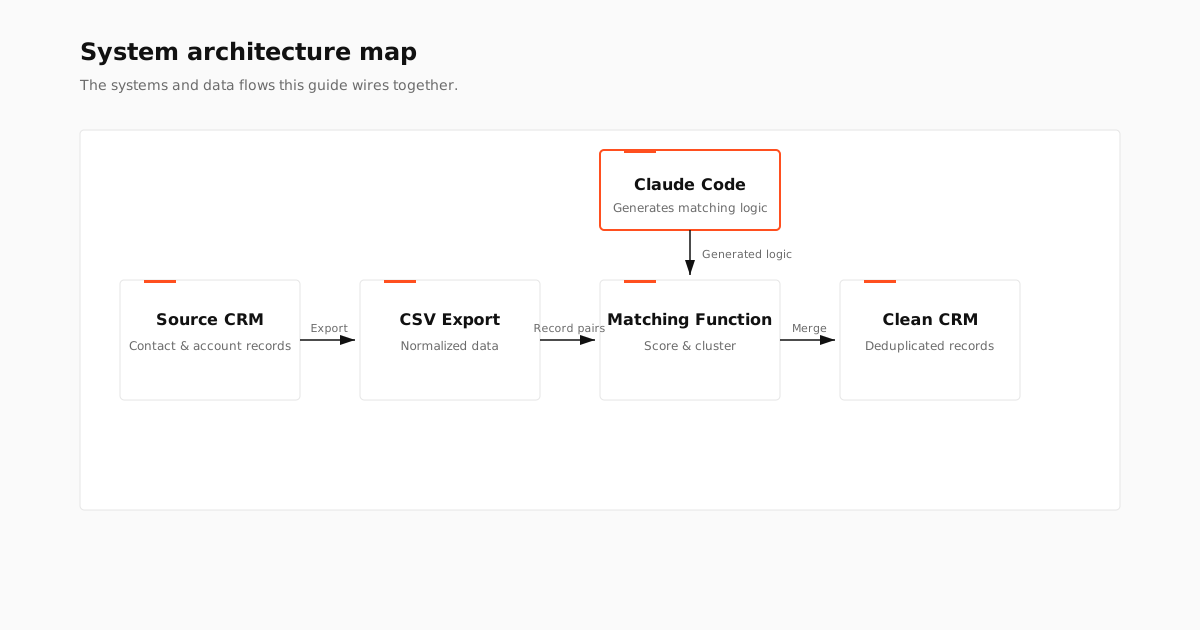
Export CRM data to CSV with consistent field names and clean values. Normalize names, emails, and phone numbers to a standard format. Remove extra spaces, standardize capitalization, and parse full names into first and last components.
- This preprocessing improves Claude's ability to generate accurate matching logic.
- Structure the prompt to specify input format, output requirements, and edge cases.
Map the workflow before choosing the platform. The practical test is whether data moves cleanly between the systems that sales, marketing, finance, and operations already use. Ownership matters because broken mappings usually show up after the purchase.
- List the systems that must exchange data after launch.
- Assign owners for mapping, testing, errors, and release review.
- Check whether support matches the team that will operate it.
Decision note: Decision note: In How to Deduplicate CRM Records Using Claude Code: A GTM Engineer's Guide, use preparing data for claude analysis to decide what must be verified before vendor conversations move forward.
A review page is strongest when it explains what the signal can and cannot prove. Ratings can reveal recurring friction, but they do not replace a fit check. Buyers still need to test the category, the workflow, and the support model.
- Check whether complaints point to fit problems or setup problems.
- Use demos and samples to verify what reviews cannot prove.
- Compare review patterns against your own team size and workflow.
Decision note: Decision note: Treat review evidence as a filter for better questions, not as proof that a vendor fits your environment.
Generating Matching Logic with Claude
Provide Claude with a clear specification: input fields, desired output, and matching rules. Request a function that takes two records and returns a match score. Use Levenshtein distance for name comparison, exact match for email, and partial match for phone.
- Set thresholds for strong, possible, and no match.
- Test the logic on sample pairs before scaling.
Separate product fit from account fit. Large platforms can solve real workflow problems, but they also bring packaging, admin, and migration questions. The page should help the buyer decide which questions to ask before a demo becomes procurement.
- Confirm which team owns data hygiene after implementation.
- Map the handoff between sales, marketing, and operations.
- Check whether reporting stays useful without manual cleanup.
Decision note: Decision note: In How to Deduplicate CRM Records Using Claude Code: A GTM Engineer's Guide, use generating matching logic with claude to decide what must be verified before vendor conversations move forward.
Building the Deduplication Script
Write a script that loads the normalized CSV, applies the Claude-generated matching function to record pairs, and outputs a list of duplicates. Use a nested loop or pairwise comparison library. Flag pairs above a match threshold.
- Include record IDs, confidence scores, and mismatched fields.
- Output to a review file, not directly to the CRM.
Never auto-merge without human approval.
Use review sites as directional evidence, not a final answer. The useful signal is pattern recognition across buyers with similar team size, data needs, and implementation constraints. Pair review research with vendor docs, product demos, and your own sample workflow.
- Compare review patterns against your own team size and workflow.
- Check whether complaints point to fit problems or setup problems.
- Use demos and samples to verify what reviews cannot prove.
Decision note: Decision note: In How to Deduplicate CRM Records Using Claude Code: A GTM Engineer's Guide, use building the deduplication script to decide what must be verified before vendor conversations move forward.
Integrating with CRM APIs
Authenticate using API keys or OAuth. Use CRM-specific endpoints to read and update records. Respect rate limits by adding delays between requests.
Decision note: Use bulk update endpoints where available.
Log all changes for audit purposes. Test merge execution in a sandbox first.
Map the workflow before choosing the platform. The practical test is whether data moves cleanly between the systems that sales, marketing, finance, and operations already use. Ownership matters because broken mappings usually show up after the purchase.
- List the systems that must exchange data after launch.
- Assign owners for mapping, testing, errors, and release review.
- Check whether support matches the team that will operate it.
Decision note: Decision note: In How to Deduplicate CRM Records Using Claude Code: A GTM Engineer's Guide, use integrating with crm apis to decide what must be verified before vendor conversations move forward.
Handling Edge Cases and False Positives
Some records share email addresses but represent different people, like assistants using shared inboxes. Others have similar names but work at different companies. Ownership differences suggest separate contacts.
- Do not merge records with conflicting lifecycle stages or owners.
- Flag these for manual review instead of automatic action.
Use review sites as directional evidence, not a final answer. The useful signal is pattern recognition across buyers with similar team size, data needs, and implementation constraints. Pair review research with vendor docs, product demos, and your own sample workflow.
- Compare review patterns against your own team size and workflow.
- Check whether complaints point to fit problems or setup problems.
- Use demos and samples to verify what reviews cannot prove.
Decision note: Decision note: In How to Deduplicate CRM Records Using Claude Code: A GTM Engineer's Guide, use handling edge cases and false positives to decide what must be verified before vendor conversations move forward.
Automating Ongoing Duplicate Prevention
Schedule weekly deduplication jobs using cron or a workflow tool. Trigger checks on new record creation via webhooks. Apply the same matching logic at ingestion time.
Decision note: Block duplicates before they enter the system.
Update matching rules as data quality improves.
Map the workflow before choosing the platform. The practical test is whether data moves cleanly between the systems that sales, marketing, finance, and operations already use. Ownership matters because broken mappings usually show up after the purchase.
- List the systems that must exchange data after launch.
- Assign owners for mapping, testing, errors, and release review.
- Check whether support matches the team that will operate it.
Decision note: Decision note: In How to Deduplicate CRM Records Using Claude Code: A GTM Engineer's Guide, use automating ongoing duplicate prevention to decide what must be verified before vendor conversations move forward.
Frequently Asked Questions
Can Claude fully automate CRM deduplication without human review?
No. Claude can generate the core logic, but human oversight is required to validate merge decisions, especially for records with conflicting data or different owners. Automation should flag candidates, not execute merges blindly.
What CRM systems does this approach work with?
The method applies to any CRM with export capabilities and a public API-Salesforce, HubSpot, Microsoft Dynamics, and Zoho are all viable targets. The underlying code logic remains consistent across platforms.
How do I avoid hitting API rate limits during cleanup?
Implement exponential backoff, batch processing, and respect documented rate limits. For large datasets, spread operations over time and use bulk endpoints where available.
Is fuzzy matching reliable for name and company fields?
Fuzzy matching improves recall but increases false positives. Use it in combination with exact matches on email or phone where possible. Adjust thresholds based on data quality and tolerance for error.
Should deduplication run before or after CRM syncs?
Ideally, deduplication logic should run at ingestion time, before records enter the CRM. If that's not possible, schedule regular cleanup jobs during low-activity periods to minimize disruption.

Rome Thorndike
Rome Thorndike is the CEO & Founder of Provyx, which provides GTM intelligence and data validation for healthcare companies, including EngagedMD and BTL Industries. He helped establish HubSpot reporting at Pacdora, owned pipeline reporting at Datajoy, and led revenue at Firmograph.
Connect on LinkedIn