GTM Engineer Abbreviations: A Field Guide to the Acronyms That Define the Role
If you've ever read a GTM engineer job description and felt like you were decoding a Cold War cipher, you're not alone.
The role thrives on acronyms. Some are universal, some are tribal, all are necessary. This guide maps the most common abbreviations GTM engineers encounter, explains what they mean in practice, and connects them to the systems and workflows they represent. No fluff, no fabricated use cases. Just a reference built for clarity.
Whether you're hiring for the role, applying for it, or trying to understand what your revenue operations team is saying in Slack, this field guide gives you the vocabulary and the context behind it.
Each section pairs the abbreviation with the actual infrastructure it points to, so you can move from recognition to working knowledge without guessing.
Why GTM Engineers Speak in Acronyms
GTM engineers work where sales, marketing, and engineering overlap. Each domain brings its own vocabulary, and abbreviations compress complex system references into shorthand that fits a Slack message or a Jira ticket. The cost is opacity for anyone outside the conversation.
- When a sync fails between your MAP and CRM, nobody wants a three-sentence explanation of what each system does.
- Abbreviations let engineers reference infrastructure quickly, but they also create a knowledge barrier for new hires and cross-functional partners.
- It's when teams use them without agreeing on definitions.
The shorthand exists because speed matters. They want the fix. The real problem isn't the acronyms themselves. CRM can mean Salesforce to one person and HubSpot to another.
CDP can mean Segment or it can mean a custom-built warehouse pipeline. The abbreviation is the same; the infrastructure behind it is not. This guide treats each abbreviation as a pointer to real infrastructure, not a vocabulary test. The goal is operational fluency.
You should be able to hear a term in a planning meeting and immediately know which system, which data flow, and which failure modes it implies. Engineers who can make that mental map quickly are the ones who debug faster and ship integrations with fewer surprises.
Core Systems: CRM, ERP, CDP, MAP
These four abbreviations describe the pillars of GTM infrastructure. CRM, or Customer Relationship Management, is the central ledger for leads, contacts, and accounts. Salesforce and HubSpot dominate this category.
- GTM engineers interact with CRM systems through APIs, custom objects, workflow rules, and field-level permissions.
- ERP, or Enterprise Resource Planning, handles billing, invoicing, and financial data.
- GTM engineers rarely own ERP systems, but they build the bridges between CRM and ERP so revenue data flows without manual entry.
NetSuite, SAP, and Oracle sit here. CDP, or Customer Data Platform, unifies behavioral and demographic data across touchpoints. Segment, mParticle, and Bloomreach are common. GTM engineers configure CDP destinations, manage identity resolution rules, and ensure event schemas stay consistent.
MAP, or Marketing Automation Platform, drives campaigns and lead nurturing. Marketo, Pardot, and HubSpot Marketing Hub live here. The overlap between MAP and CRM is where most sync failures happen. Field mapping drift, duplicate records, and stale lead statuses all trace back to misaligned configurations between these two systems.
GTM engineers don't just integrate these platforms. They debug sync failures, enforce data hygiene, and build guardrails that prevent bad data from propagating. If you don't know which system owns which field, you will eventually ship a bug that corrupts lead routing or breaks reporting.
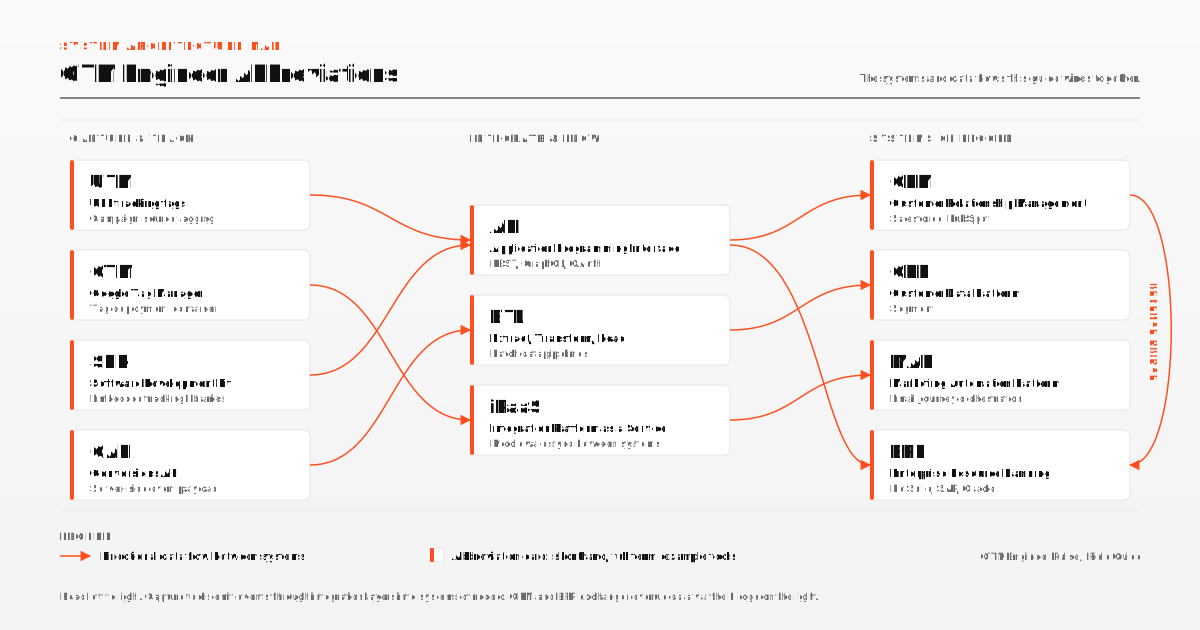
Data Flow and Integration Tools: API, SDK, ETL, iPaaS
APIs, or Application Programming Interfaces, are the primary way GTM engineers connect systems. REST and GraphQL APIs dominate, but understanding rate limits, pagination, and authentication methods is non-negotiable. OAuth flows break silently when tokens expire, and API keys get rotated without warning.
- GTM engineers monitor these failure modes because a broken auth token can pause an entire lead pipeline.
- SDKs, or Software Development Kits, offer pre-built libraries for embedding tracking or functionality.
- The Google Tag Manager SDK for mobile apps is a common example.
SDKs reduce boilerplate code, but they also introduce version dependency risks. An SDK update can change event payloads, and if your downstream CDP expects the old schema, data gets lost. ETL, or Extract, Transform, Load, describes the process of moving and shaping data between systems.
Fivetran and Stitch automate much of this, but GTM engineers still define transformations, handle schema drift, and manage backfills. IPaaS, or Integration Platform as a Service, platforms like Workato and Zapier let engineers orchestrate workflows without writing everything from scratch. These platforms trade flexibility for speed.
They work well for standard patterns but hit limits when logic gets complex or when error handling needs custom code. GTM engineers choose between building custom integrations and configuring iPaaS recipes based on how much control the workflow demands.
Analytics and Tracking: UTM, GA, GTM, CAPI
UTM parameters tag URLs to track campaign sources, mediums, and content. They are basic but foundational. GTM engineers enforce naming conventions because inconsistent UTM tags fragment attribution reports.
- Google Analytics, or GA, remains a common analytics destination.
- GA4's event-driven model changed how data is structured, and many teams are still adjusting their event schemas.
- GTM engineers configure GA4 events to match business logic, not just default pageview tracking.
Google Tag Manager, also abbreviated GTM, is a container for deploying tracking scripts without code changes. This is where the abbreviation collision gets confusing. In a job posting, GTM usually means Go-To-Market. In a tracking discussion, GTM usually means Google Tag Manager.
Context determines which one applies. GTM engineers configure triggers, variables, and tags inside the container to capture user behavior across pages and events. CAPI, or Conversion API, is Meta's server-side alternative to browser-based tracking. GTM engineers implement CAPI to bypass ad blockers and improve attribution accuracy.
The setup involves sending conversion events from your server directly to Meta's API, which requires matching event payloads with browser-side pixel data to avoid duplication. Getting this wrong inflates conversion counts and breaks ad platform optimization.
Sales and Marketing Ops Terms: SDR, MQL, SQL, BDR
These abbreviations look like sales slang, but to GTM engineers they are data points with automation attached. SDR, or Sales Development Representative, and BDR, or Business Development Representative, are roles that generate and qualify leads. The distinction varies by company.
- Some teams use SDR for inbound and BDR for outbound.
- GTM engineers don't need to resolve the naming debate.
- They need to know which role maps to which CRM record owner field, because lead routing logic depends on it.
Others flip the definitions. MQL, or Marketing Qualified Lead, and SQL, or Sales Qualified Lead, are status fields that trigger automation. When a lead crosses a scoring threshold in the MAP, it becomes an MQL. When sales accepts it, it becomes an SQL.
GTM engineers map these values across systems, ensuring lead scoring logic syncs from MAP to CRM, and that handoff alerts fire correctly. Misalignment here breaks the funnel. Leads get stuck in wrong statuses, sales reps miss alerts, and marketing complains about poor follow-up.
The root cause is usually a field mapping mismatch or a scoring rule that changed in one system but not the other. GTM engineers own the bridge between these definitions and the infrastructure that enforces them.
Technical Infrastructure: DNS, CNAME, SSL, SSO
GTM engineers often touch infrastructure that lives outside marketing and sales tools. DNS, or Domain Name System, routes traffic. When setting up tracking domains or email sending infrastructure, DNS records determine whether your tracking pixels load and whether your emails reach inboxes.
- CNAME records alias subdomains, often used for tracking URLs or custom endpoints in tools like Marketo or Pardot.
- SSL, or Secure Sockets Layer, ensures encrypted connections between browsers and servers.
- Most platforms now require SSL on tracking domains, and misconfigured certificates break pixel loads silently.
GTM engineers don't always own SSL provisioning, but they diagnose the failures when tracking stops working. SSO, or Single Sign-On, simplifies access across tools using protocols like SAML or OAuth. GTM engineers configure SSO to reduce login friction and improve security.
When SSO breaks, entire teams lose access to their core systems, so the stakes are high. These infrastructure terms feel distant from lead routing and campaign tracking, but they sit underneath everything. A broken CNAME can take down email tracking. An expired SSL certificate can silence conversion data.
SSO misconfigurations can lock out your revenue operations team on a Monday morning. GTM engineers need enough infrastructure literacy to diagnose these issues or escalate them quickly.
Compliance and Data Governance: PII, GDPR, CCPA, TOS
PII, or Personally Identifiable Information, is any data that can identify an individual. Email addresses, IP addresses, phone numbers, and even cookie IDs fall under this umbrella depending on the jurisdiction. GTM engineers must identify where PII flows and ensure it is masked, hashed, or blocked per company policy.
- Every new integration or tracking event is a potential PII leak.
- GDPR, or General Data Protection Regulation, sets legal requirements for data handling in the European Union.
- CCPA, or California Consumer Privacy Act, does the same for California residents.
This isn't a one-time audit. The specifics differ, but both require consent management, data subject access workflows, and documented retention policies. GTM engineers implement the technical controls that make compliance possible. TOS, or Terms of Service, for platforms like Google Ads or LinkedIn restrict how data can be collected and used.
Violating platform TOS can break integrations, suspend accounts, or trigger audits. GTM engineers need to read these terms, not just accept them. Some platforms prohibit sending certain event types or restrict data sharing with third parties. Building a tracking setup that violates TOS creates operational risk that surfaces only when the platform enforces it.
Compliance isn't a legal afterthought. It is a design constraint that shapes what GTM engineers can build.
Emerging and Niche Terms: ABM, RLM, PLG, CRO
ABM, or Account-Based Marketing, shifts focus from individual leads to entire accounts. GTM engineers support this by syncing firmographic data, engagement scores, and account hierarchies across systems. ABM requires tighter alignment between sales and marketing data, which means more complex field mappings and more sync points to maintain.
- RLM, or Revenue Lifecycle Management, is a newer term describing end-to-end revenue operations.
- It aims to unify marketing, sales, and customer success data under one operational model.
- Tools in this space promise a lot, but the implementation work still falls on GTM engineers who connect the underlying systems.
PLG, or Product-Led Growth, changes data priorities. Activation events, feature usage, and in-product behavior become the signals that drive segmentation and scoring. GTM engineers working in PLG companies spend more time on product analytics instrumentation than on traditional marketing automation. CRO, or Conversion Rate Optimization, relies on A/B test data.
Tools like Optimizely or VWO run experiments, and GTM engineers pull that data into analytics platforms for analysis. The challenge is ensuring test variants don't pollute attribution data or break funnel reporting. These terms represent evolving models, not fixed systems.
GTM engineers bridge them with data pipelines, schema definitions, and integration logic that adapts as the business strategy shifts.
Frequently Asked Questions
What does GTM mean in the context of engineering?
GTM stands for Go-To-Market and refers to the systems and processes that drive customer acquisition and revenue. In engineering contexts, GTM engineers focus on the technical infrastructure, including APIs, data flows, and tracking, that supports sales, marketing, and customer success operations.
Is Google Tag Manager the same as GTM in revenue operations?
No. Google Tag Manager is a web tool for deploying tracking scripts. In revenue operations, GTM usually means Go-To-Market. Context matters. GTM engineers may use Google Tag Manager as part of their toolkit, but the role extends far beyond it.
What is the difference between a CDP and a CRM?
A CRM manages sales interactions and lead lifecycle. A CDP aggregates behavioral and demographic data from multiple sources to create unified customer profiles. GTM engineers often connect both, ensuring sales teams see enriched data while maintaining segmentation for marketing.
Do GTM engineers write code?
Yes, but not always in traditional languages. GTM engineers frequently write JavaScript for tags, configure API endpoints, debug JSON payloads, and write SQL for data validation. The code is often embedded in tools like Google Tag Manager, Segment, or iPaaS platforms rather than standalone applications.
How do GTM engineers handle data privacy laws like GDPR?
They implement technical controls such as IP masking, cookie consent checks, and data routing rules to ensure compliance. This includes configuring tools to block PII in logs, setting up data retention policies, and auditing tracking setups to align with legal requirements.

Rome Thorndike
Rome Thorndike is the CEO & Founder of Provyx, which provides GTM intelligence and data validation for healthcare companies, including EngagedMD and BTL Industries. He helped establish HubSpot reporting at Pacdora, owned pipeline reporting at Datajoy, and led revenue at Firmograph.
Connect on LinkedIn